Key Takeaways
- DMC software is a specialised platform that manages the complete operations of a Destination Management Company — from itinerary building to voucher issuance.
- It replaces disconnected tools (Excel, email, WhatsApp) with a single, automated workflow that reduces errors and speeds up quoting.
- Core modules include itinerary builder, supplier management, CRM, booking automation, multi-currency pricing, and financial reporting.
- Modern platforms like TraveleXe incorporate AI for dynamic pricing, itinerary suggestions, and demand forecasting.
- DMC software is not the same as a booking engine. It covers the operational back-end that a booking engine simply cannot handle.
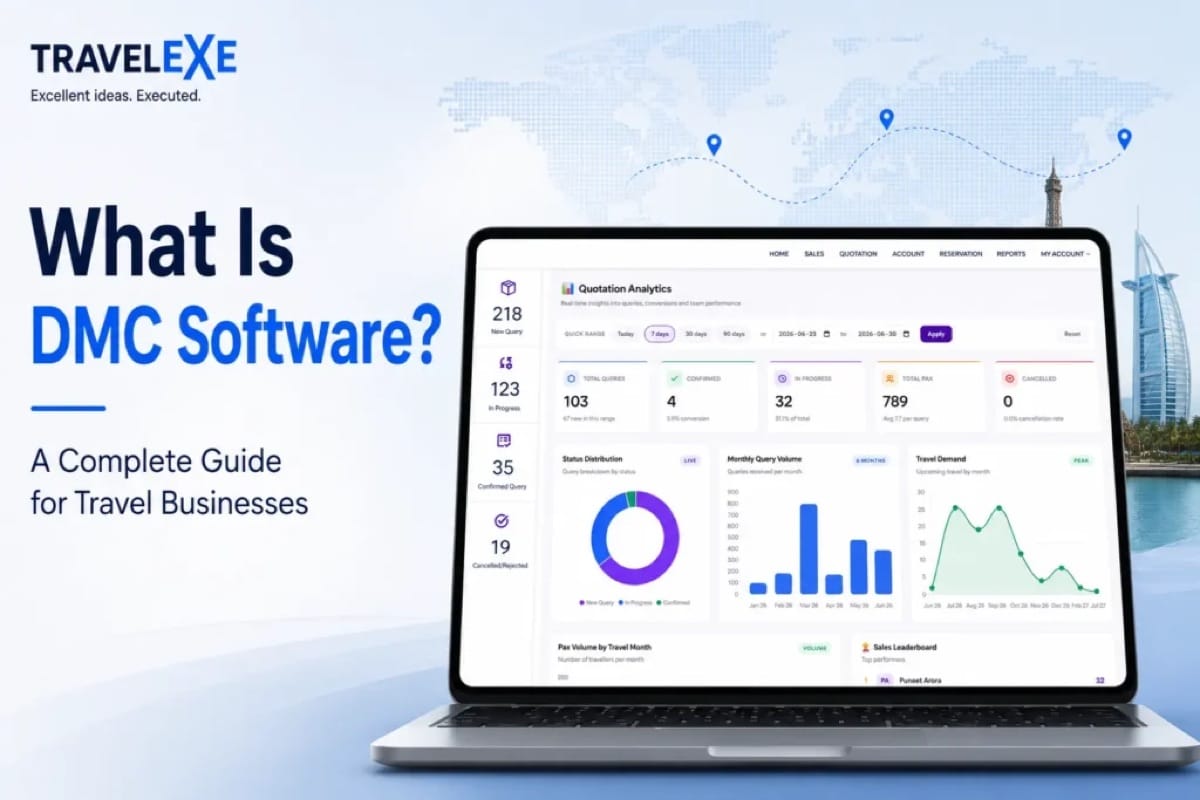
DMC software is a specialized platform that helps destination management companies and tour operators manage itineraries, suppliers, bookings, quotations, customer information, and operations from one centralized system. It replaces the patchwork of spreadsheets, email threads, and manual processes that most travel businesses rely on, bringing everything into a single, connected workflow.
If you run a DMC, inbound tour operator, or travel agency and still rely on Excel for itineraries or WhatsApp for supplier confirmations, this guide will explain exactly what DMC software is, how it works, what to look for — and whether it's the right move for your business in 2026.
📋 How We Evaluated Modern DMC Software
To prepare this guide, we reviewed leading DMC software platforms, analysed the operational requirements of destination management companies across different scales, studied current industry trends, and compared features based on real-world usability rather than marketing claims. Our evaluation focused on workflow efficiency, scalability, B2B distribution capability, API readiness, and support quality. The goal is to help travel businesses make a genuinely informed decision, not push any single platform.
What Is DMC Software?
DMC software — short for Destination Management Company software — is a purpose-built travel technology platform that handles everything a destination management company needs to run its operations efficiently.
At its core, it manages the journey from first inquiry to final payment: building itineraries, generating quotations, contracting suppliers, confirming bookings, issuing vouchers, tracking margins, and producing financial reports. Everything that would otherwise live in a combination of Excel files, email inboxes, and manual notebooks is centralised in one system.
Unlike a standard booking engine that focuses on the customer-facing transaction, DMC software is primarily an operational platform. It works behind the scenes to ensure the right services are booked, the right suppliers are confirmed, the right documents are sent — and that the business is actually making money on every booking.
In simple terms: A booking engine is the front door. DMC software is everything that happens behind it — supplier contracts, itinerary logic, margin tracking, team coordination, and back-office reporting.
One of the most common misconceptions we encounter is that a booking engine is "enough." In practice, the booking engine only handles the transaction. Everything upstream — building the right product at the right price, contracting suppliers, managing allocations, and tracking whether the business is profitable — happens in the DMC platform. Without both, travel businesses are either leaving money on the table or managing the gap manually.
What Does a Destination Management Company (DMC) Do?
A Destination Management Company is a professional organisation with local knowledge, expertise, and resources that designs and delivers travel experiences in a specific destination. DMCs work primarily in the B2B space, providing services to tour operators, travel agencies, and corporate clients who need on-the-ground support.
Typical DMC activities include:
- Designing custom itineraries and travel packages
- Contracting local hotels, transport, activities, and guides
- Managing group travel logistics (MICE, incentives, conferences)
- Issuing booking confirmations, vouchers, and rooming lists
- Handling on-ground coordination and emergency support
- Distributing travel products to B2B agents through net rates and markup structures
All of these activities generate enormous amounts of data. Without the right software, it ends up scattered across disconnected files, creating operational risk at every step.
During discussions with destination management companies evaluating software, one recurring challenge stands out: quotations often take hours because rates are scattered across Excel sheets and supplier emails. Sales teams lose track of which version of a proposal was sent, operations teams recreate the same data in a separate file, and finance works from a third spreadsheet entirely. Centralising this into a single workflow is usually the first — and most immediately impactful — operational improvement businesses notice after implementation.
Evolution of DMC Software
DMC operations have changed significantly over the past two decades. In the early 2000s, most destination management companies managed everything on paper or in basic spreadsheets. The 2010s brought purpose-built desktop software that helped with quotations and bookings, but these systems were often rigid, expensive, and hard to integrate with other tools.
By 2020, cloud-based platforms had changed the game, making it possible for DMCs of any size to access enterprise-grade software without heavy IT investment. Today's platforms go further still, incorporating AI-powered pricing, real-time API connections to GDS systems like Amadeus and Sabre, and mobile access for field teams.
The shift from desktop software to cloud-native, API-first platforms is not a trend — it's the new baseline. DMCs still running legacy systems are increasingly at a competitive disadvantage on speed, accuracy, and scalability. For businesses looking to manage their full inventory — flights, hotels, transfers, and packages — through a unified inventory management system, the platform choice matters significantly.
The businesses that adopted cloud-based DMC platforms between 2018 and 2022 are now processing significantly higher booking volumes without proportionally increasing headcount. The ones that delayed — often citing implementation complexity or cost — are now playing catch-up against competitors who are faster, more accurate, and more responsive to agents. The technology gap between early adopters and late movers in this space has widened considerably.
Why Travel Businesses Need DMC Software in 2026
Travel volumes have recovered strongly, but the business environment has become more competitive and more complex at the same time. Clients expect instant proposals, personalised itineraries, and transparent pricing. Suppliers demand faster confirmations. B2B agents want real-time availability and automated vouchers.
Manual workflows simply cannot keep up with these expectations at scale. The numbers make a clear case:
Beyond operational efficiency, DMC software directly affects revenue. Faster quotation turnaround means more bookings won. Accurate margin tracking means no more unintentional underselling. And a proper B2B agent portal means your agent network can book independently without your team handling every request manually.
The revenue impact of slow quoting is often underestimated. When an agent sends the same inquiry to three DMCs and receives a professional, accurate proposal from one within 30 minutes while the others respond the next day. The outcome is predictable. Speed of response is one of the most measurable competitive advantages that DMC software delivers, and it compounds over time as agents learn which DMC to call first.
Common Problems Before Using DMC Software
| Task | Without DMC Software | With DMC Software |
|---|---|---|
| Itinerary Building | Excel sheets, manual copy-paste, no templates | Drag-and-drop builder with supplier library, auto-generated PDF |
| Quotations | Manual calculation, hours per quote, error-prone | Auto-generated in minutes from pre-loaded rates |
| Supplier Confirmation | WhatsApp/email, no tracking, missed replies | Automated service orders, real-time status tracking |
| Vouchers | Word/PDF created manually per booking | Auto-generated on confirmation, sent by email |
| Margin Tracking | Spreadsheet formulas, often wrong or outdated | Real-time per-booking margin calculation |
| Currency Conversion | Manual lookup, inconsistent rates, mistakes | Live multi-currency pricing with markup rules |
| Reporting | Monthly Excel reports, time-consuming, delayed | Real-time dashboards and P&L reports on demand |
How DMC Software Works
A modern DMC platform connects six core operational areas into a single, continuous workflow. Here's how a typical inquiry flows through the system — from first contact to final voucher — without any data being re-entered manually.
DMC Booking Workflow — Lead to Invoice
Sales & CRM
Inquiry captured, lead assigned, client history tracked. No more lost emails.
Quotation
Itinerary built from supplier library. Rates applied automatically. Branded proposal generated in minutes.
Supplier Management
Service orders sent to suppliers on confirmation. Availability and allocation checked in real time.
Operations
Rooming lists, transport assignments, and service schedules generated and distributed automatically.
Accounting
Invoices, payment tracking, VAT handling, and margin reporting linked to each booking.
Reporting
P&L per booking, per route, per agent. Sold vs available, revenue vs cost — all on demand.
The biggest operational gain from this connected workflow is not the automation itself. The real benefit is eliminating the handover failures between departments. In manual operations, information regularly gets lost when it moves from sales to operations to finance. Each team recreates the same data in their own format. A unified DMC platform means every department works from the same booking record, in real time, with no data re-entry at any stage.
Core Features of Modern DMC Software
Itinerary Builder
A drag-and-drop interface that pulls from your loaded supplier inventory to build day-by-day travel packages with descriptions, images, and pricing. The best systems auto-generate branded PDF proposals directly — no design work required. This single feature alone can cut proposal creation time from hours to under 20 minutes.
Supplier Management
Centralised storage for all hotel contracts, transport agreements, activity suppliers, and guide rates — including contract validity, allocation controls, net rates, and payment terms. When a rate changes, it updates across all linked itineraries automatically. For DMCs managing large supplier networks, a dedicated inventory management system integrated directly into the platform removes the need for separate supplier databases.
CRM
A built-in travel CRM tracks every client and agent interaction — inquiry history, past bookings, communication logs, and follow-up reminders. Without this, the same client information gets re-entered multiple times, and follow-ups fall through the cracks.
Voucher Generation
Automated vouchers generated at the point of booking confirmation, formatted with the booking reference, service details, and supplier contacts, then sent directly to the client or agent by email. No more manually creating Word documents for each booking.
Multi-Currency Pricing
Essential for any DMC working with international clients and suppliers across different markets. The system applies live exchange rates and pre-set markup rules by currency, agent type, or market, removing the manual conversion errors that come from doing this by hand.
Margin Tracking
Real-time visibility on the profit margin of every booking — from gross cost to selling price to net margin — across all components (accommodation, transport, activities, guides). Margin tracking prevents the costly mistake of confirming bookings that aren't actually profitable.
API Integrations
Connections to GDS platforms (Amadeus, Sabre, Galileo), third-party hotel APIs, activity suppliers, and payment gateways. API-first platforms pull live availability and pricing rather than relying on manually loaded static rates. DMCs looking for seamless XML API integration can connect their supplier inventory directly without manual intervention.
GDS Integration
For DMCs managing flight-inclusive packages, direct GDS connectivity is critical. It allows the system to search and book flights from Amadeus, Sabre, or Galileo without leaving the DMC platform, creating a truly end-to-end package workflow.
Reporting & Analytics
Real-time dashboards showing bookings by agent, revenue by destination, cost vs revenue, supplier performance, and team productivity. This replaces the monthly Excel report that takes someone half a day to compile and is already outdated by the time it's finished.
Mobile Access
Cloud-based DMC software accessible from any device — essential for operations managers and field staff who need to check booking status, supplier confirmations, or client information on the move.
AI Automation
Increasingly, leading platforms incorporate AI for pricing recommendations, itinerary suggestions, and customer communication. This is no longer an advanced feature. By 2026, it has become a standard expectation.
When evaluating DMC software features, resist the temptation to score platforms on the number of features listed. The more important question is depth: does the supplier management module handle allocation by room type, or just by property? Does the margin tracking work at the component level, or only at the booking total? Feature breadth is visible in demos. Feature depth only reveals itself during implementation. Ask vendors to show you the specific workflow that corresponds to your most complex booking type.
Benefits of Using DMC Software
Time Saving
Automating itinerary creation, quotation generation, voucher issuance, and supplier communication saves an average of 15 or more hours per team member per week. That time goes back into selling, client management, and product development.
Cost Saving
Businesses that implement DMC automation typically see a 25–30% reduction in administrative overhead within the first six months. Fewer errors also mean fewer refunds, supplier disputes, and reputational costs.
Faster Quoting
The difference between winning and losing a booking is often response time. A DMC that can send a professional, accurate proposal in 20 minutes will consistently outperform one that takes two days to compile the same quote manually.
Better Team Collaboration
When sales, operations, and finance all work within the same platform, information flows without manual handover. Everyone sees the same booking status, same supplier confirmations, same payment position — at the same time.
Better Customer Experience
Faster proposals, professional branded documents, automated confirmations, and accurate real-time information create a noticeably better experience for agents and end clients, which drives repeat business and referrals. For DMCs operating a B2B agent portal, this experience improvement is particularly visible in agent satisfaction and repeat booking rates.
Higher Profitability
Real-time margin visibility, markup automation, and accurate cost tracking mean every booking is priced correctly. Over a year, the accumulated impact of eliminating margin errors and underselling can be significant.
Discover how TraveleXe helps DMCs streamline itinerary creation, supplier management, and B2B operations in one platform.
Explore TraveleXe DMC PlatformDMC Software vs Booking Software
This is one of the most common points of confusion when travel businesses start evaluating technology. A booking engine and DMC software are fundamentally different tools. In most cases, businesses need both.
| Feature | Booking Engine | DMC Software |
|---|---|---|
| Primary purpose | Customer-facing online booking | Operational back-office management |
| Itinerary building | ✘ | ✔ Full builder with PDF output |
| Supplier contracting | ✘ | ✔ Contract management module |
| Margin & markup tracking | ✘ | ✔ Real-time per booking |
| Voucher generation | ⚬ Basic | ✔ Automated, branded |
| B2B agent portal | ⚬ Some have it | ✔ Core module |
| CRM | ✘ | ✔ Built-in |
| Financial reporting | ✘ | ✔ P&L per booking |
| Online payment | ✔ Core feature | ⚬ Via integration |
Full-stack platforms combine both, offering DMC back-office operations alongside a booking engine, so businesses don't need separate systems to integrate and maintain independently.
DMC Software vs Tour Operator Software
The terms are often used interchangeably, but there are meaningful operational differences. DMC software tends to focus on inbound tourism, managing destination services for incoming groups, handling local suppliers, and distributing through B2B channels. Tour operator software often prioritises outbound package building, B2C sales, and distribution through OTA channels.
| Capability | DMC Software | Tour Operator Software |
|---|---|---|
| Inbound tour management | ✔ Primary focus | ⚬ Partial |
| Local supplier contracting | ✔ Core module | ⚬ Basic |
| Outbound package building | ⚬ Some platforms | ✔ Primary focus |
| B2B agent distribution | ✔ Core module | ✔ Core module |
| GDS integration | ⚬ Via API | ✔ Often built-in |
| MICE & group management | ✔ Strong focus | ⚬ Limited |
Who Should Use DMC Software?
DMC Software is right for you if:
- You manage more than 20–30 bookings per month and rely on Excel or manual tools
- Your quotation process takes more than a few hours per inquiry
- You work with multiple suppliers and struggle to track contracts and allocations
- You distribute through B2B agents and need a proper agent portal
- Your operations, sales, and finance teams use separate tools that don't communicate
- You manage group travel, MICE, or incentive programs at scale
- You are growing and need a system that scales without adding headcount
DMC software is used by inbound and outbound tour operators, destination management companies, luxury travel specialists, MICE companies, travel agencies managing packages, and B2B wholesale travel businesses. Company size matters less than operational complexity. Even a small DMC processing 50 group bookings per month will benefit significantly from automation.
Who Should NOT Buy DMC Software
Honest guidance means acknowledging when a platform is not the right fit. DMC software is a meaningful investment, and for some businesses, the timing or the fit simply isn't right yet.
- If you process fewer than 15–20 bookings per month — the ROI case is harder to make. At this volume, simpler tools or even well-structured spreadsheets may be sufficient while you grow.
- If your entire operation is a single person — the complexity and cost of a full DMC platform may outweigh the benefit. Start with lighter-touch quotation tools and revisit when you hire your first operations staff member.
- If you are a pure OTA with no custom package building — you likely need a booking engine and supplier API aggregation more than you need DMC operations tools. The requirements are fundamentally different.
- If you have no internal IT capacity and no onboarding budget — implementation without proper data migration and staff training consistently underdelivers. The technology is only as good as the adoption behind it.
- If you need a solution live in under two weeks — proper DMC platform implementation takes time. Rushing it creates more problems than the manual workflow you're replacing.
The businesses that struggle most with DMC software implementations are those that bought before they were operationally ready — no clear process documentation, no data clean-up done in advance, and no internal champion driving adoption. A platform is not a substitute for process clarity. Before investing in software, map your current booking workflow on paper first. If you can't describe it clearly, the software won't fix it — it will just automate the confusion.
Do You Need DMC Software? — Decision Tree
Find Out in 60 Seconds
AI Trends Shaping DMC Software in 2026
Artificial intelligence is no longer a future feature in travel technology. It's being built into operational platforms today. Here's how AI is changing what DMC software can do:
AI-Powered Pricing
Dynamic pricing engines that adjust rates based on demand signals, competitor pricing, seasonality, and booking lead time. Instead of loading fixed rate sheets that are outdated within weeks, AI pricing keeps your inventory commercially optimised in real time.
AI Itinerary Builder
AI-assisted itinerary creation that suggests services, experiences, and routing based on client preferences, past booking patterns, and destination popularity data. This speeds up the proposal process and improves personalisation at scale.
AI Chatbots
Automated first-response tools that handle initial client and agent inquiries by collecting requirements, answering availability questions, and triaging requests before a human team member takes over. This is particularly valuable for DMCs receiving a high volume of B2B agent queries.
AI Forecasting
Demand forecasting tools that predict booking volumes by destination and service category, helping operations teams manage supplier allocations more accurately and avoid both overbooking and missed revenue opportunities.
AI Analytics
Intelligent reporting that goes beyond standard dashboards, identifying patterns, flagging anomalies such as consistently low-margin routes, and surfacing recommendations that a static report would never reveal.
| Feature | Traditional DMC Software | Modern AI-Powered DMC Software |
|---|---|---|
| Pricing | Fixed rate sheets, manual updates | Dynamic AI pricing, real-time adjustment |
| Itinerary | Manual selection from supplier list | AI-suggested itinerary based on preferences |
| Client communication | Manual email responses | AI chatbot for first response and triage |
| Forecasting | Historical spreadsheet analysis | AI demand prediction by route and season |
| Analytics | Static monthly reports | Real-time AI-driven insights and alerts |
The practical AI value in DMC operations right now is not in chatbots or headline features — it's in pricing and itinerary speed. DMCs that use AI-assisted itinerary building are generating first drafts in minutes rather than hours, which means more proposals sent per day without increasing headcount. That compound effect on conversion rate is measurable within months, not years. Platforms offering a dedicated AI travel suite integrated into the core workflow — not bolted on as a separate tool — deliver this benefit most consistently.
How to Choose the Right DMC Software
The most common buying mistake is evaluating software by feature lists rather than operational fit. A platform that has every feature on paper is worthless if it doesn't match your actual workflow or your team can't use it.
Start by identifying your three biggest operational pain points — the things that cost you the most time or create the most errors today. Then evaluate platforms specifically on how well they solve those problems, not on the length of their feature page.
Key questions to ask every vendor before signing:
- Can I see the B2B agent portal in a live demo — not a recording?
- How long does implementation take end to end?
- Can I migrate my existing supplier contracts and historical data?
- What is your SLA for support response time?
- Does pricing scale with booking volume, or is it fixed?
- Do you have clients in my destination or market segment I can speak with?
- Can the platform scale to support a white-label travel portal if I need one in future?
For a side-by-side comparison of the top platforms on these criteria, read our guide to the Best DMC Software for Tour Operators in 2026.
Request a personalised demo to explore how TraveleXe fits your business workflow — no generic slides, just your real use case.
Request a DemoCommon Myths About DMC Software
DMC software is only for large companies.
✔ FactCloud-based DMC platforms are available at price points accessible to small DMCs. The ROI case is often strongest for smaller teams where manual work takes the highest proportional toll. A small operation saving 15 hours per week across two staff members gains 120 hours per month to redirect toward selling and client management.
Implementation takes too long — we can't afford the disruption.
✔ FactModern SaaS DMC platforms can go live in 4–8 weeks for most mid-size operations. Plan the implementation around your off-peak season and the disruption is minimal.
Our Excel system works fine — we don't need software.
✔ FactExcel works until it doesn't. The risk of a formula error, a corrupted file, or a missed update in a shared spreadsheet grows with every booking you add. Most DMCs that switch only wish they had done it sooner.
A booking engine is enough — we don't need separate DMC software.
✔ FactA booking engine handles the customer-facing transaction. Everything that happens behind it — supplier contracting, margin tracking, operational coordination — requires a DMC platform to manage properly.
Future of DMC Software
The next three to five years will see DMC software evolve significantly. AI will move from an add-on to a core operational layer, automating not just pricing but supplier negotiation, demand prediction, and customer communication at scale.
API connectivity will become the default expectation rather than a premium feature. DMCs that cannot connect to live supplier inventory in real time will be unable to compete on speed or accuracy with those that can.
Sustainability reporting is also emerging as a business requirement rather than a marketing differentiator. Corporate clients and group buyers increasingly require carbon footprint data per itinerary. DMC platforms that can generate ESG reports will carry a significant advantage in the MICE and corporate segment.
Finally, the line between DMC software and booking engine will continue to blur. The strongest platforms are already combining both into a single, unified system. For DMCs that also want to reach end consumers directly, a connected B2C travel portal becomes a natural extension of the same platform.
Final Thoughts
DMC software is not a luxury for large travel companies — it is the operational foundation that allows any destination management company or tour operator to compete effectively in 2026. The question is not whether you need it, but which platform fits your current workflow and where you plan to be in three years.
Start with your biggest pain point — whether that's slow quotations, supplier chaos, or poor margin visibility — and evaluate platforms that solve it specifically. Request live demos, not presentations. Ask to see the B2B portal in real time. And plan for the implementation properly rather than treating it as an afterthought.
The cost of good software is real. The cost of not having it — in lost bookings, operational errors, and staff time — is higher.
Speak with our travel technology experts to discover how TraveleXe can simplify daily operations and support long-term growth.
Talk to Our Experts